
The Conservation Council has recently made a submission on the draft Missing Middle Housing Reforms policy. This ACT Government policy aims to diversify the housing options for the Canberra region by increasing the stock of dual or tri-occupancy housing, townhouses and terrace homes, and low-rise apartments. Given the Government expects to construct 30,000 new homes in the next five years, the Missing Middle policy aims to ‘plan for a more compact, efficient and sustainable Canberra’. The ACT Government states that 79.7% of Canberra’s residential land is zoned as RZ1, which is referred to as ‘Suburban Zone’ and mainly consists of single houses. The Missing Middle Housing Reforms thus plans to address the dominance of freestanding, single houses in Canberra and overcome the patterns of urban sprawl. Importantly, this includes a proposal to place a ‘hard edge’ on Canberra’s sprawl.
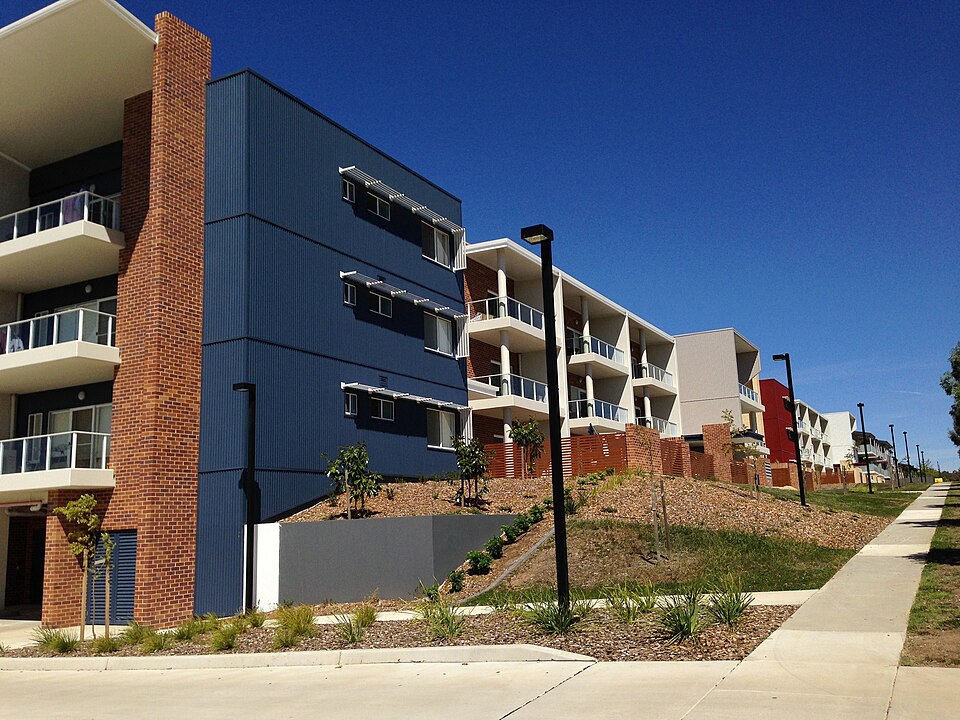
Apartments, Thynne Street, Bruce. Image: https://commons.wikimedia.org/wiki/File:Apartments,_Thynne_Street,_Bruce,_ACT,_March_2013.JPG
The Conservation Council supports the Missing Middle policy in its aim to increase urban density. Urban sprawl in Canberra has placed significant threats on native flora and fauna, particularly through habitat loss and fragmentation. The Council notes that urban sprawl has especially put pressure on Box-Gum Grassy Woodland and Natural Temperate Grassland ecological communities, as well as 30 of the ACT’s 66 threatened species. The Conservation Council notes with some concern, however, that the ACT Government has not ruled out placing the ‘hard edge’ on Canberra’s urban sprawl beyond the Western Edge. The Western Edge is a 9800 hectare patch of critically endangered ecosystems lying to Canberra’s west, which the Conservation Council has been campaigning to save from urban development.
As well as having less impact on native flora and fauna, increases in urban density will have a positive contribution towards reducing carbon emissions in the Canberra region. The ACT State of the Environment Report 2023 mentions that for the period of 2021-22, 58% of ACT’s greenhouse gas emissions came from transport. Greater urban consolidation means people will live closer to where they work and closer to the services they use on a daily basis. The resulting decrease in car dependency not only decreases carbon emissions but also associated pollution from vehicle exhausts and microplastics from tyres. In addition, the resources required to densify our city will be significantly less than if we spread even further. Densification requires fewer new roads, sewage and water pipes, electric wires etc. to service the population, meaning less impact overall.
The Conservation Council strongly believes that the Missing Middle policy should be coupled with the proactive implementation of key policies relating to transport, urban water management, urban green spaces and forest. The majority of this policy framework to support urban consolidation already exists, meaning the emphasis should be on ensuring sufficient implementation and enforcement of current policies, as well as ensuring there is adequate planning and adherence to rules of best practice. The Council notes that increased density in urban areas through urban consolidation must be matched with adequate transport planning. The consequences of not doing so is a perpetuation of car dependency and rises in traffic congestion. Transport planning to complement the Missing Middle policy could include the addition of bus services in areas of expected growth, and the construction of footpaths and protected bike lanes that encourage active travel. Given that the Missing Middle policy will likely bring benefits to the degree of walkability in Canberra, emphasis should be placed on high-quality infrastructure for active forms of transport. Furthermore, it is important that public transport planning leads demand, instead of retroactively responding to increases in demand for more services.
Adequate water management policies, especially through water sensitive urban design principles is also an important consideration. Increases in density through urban consolidation could substantially increase the percentages of impermeable surfaces, which would increase stormwater runoff, thereby limiting the recharge of ground water and decreasing soil moisture. This would have negative impacts on the extent of healthy vegetation cover, and the Conservation Council believes an important way to offset these impacts would be the uptake of rainwater tanks for individual developments which would capture runoff. Further, the ACT Government could mitigate the impacts to green spaces that urban consolidation has through water sensitive urban design infrastructure such as bioremediation structures and runoffs on road verges, which would lead to the passive watering of street trees. This would support healthy green spaces and urban forests, while also combatting the urban heat island effect.
The Conservation Council recognises there are underlying disincentives to constructing houses in the Missing Middle, which the ACT Government should take into consideration. The time and resources involved in gaining approval for the developments could lead developers to opting to develop on greenfield sites instead that have less stringent approval processes. Addressing these factors are important to ensure an effective implementation of the housing reforms.
Therefore, the Conservation Council supports the Missing Middle Housing reforms but urges its implementation to be in tandem with other important policies relating to transport planning, urban water management, and urban green spaces. This would provide a holistic plan for reducing urban sprawl and ensuring a sustainable future for the Canberra region.