
The ACT Region Conservation Council was a recent signatory, alongside other members and groups of the Australian environment movement, to an open letter calling on the Australian Government to take urgent action to address the humanitarian, legal, and environmental catastrophe unfolding in Gaza.
Israel’s expansive military assault and efforts to fully occupy Gaza has led to a dire humanitarian situation that demands immediate attention. International organisations as well as United Nations bodies, including the International Court of Justice, have found plausible claims of genocide being committed by Israel against Palestinians in Gaza. The explicit targeting of food distribution sites by the Israeli State is evidence of the genocidal tactics being employed in a deliberate attempt to starve Palestinians. The blatant disregard for international humanitarian law as Israel continues to militarily assault, blockade, and occupy Gaza and the West Bank means Australia and other states must call on Israel to abide by international law and comply with international bodies like the International Court of Justice and the International Criminal Court.
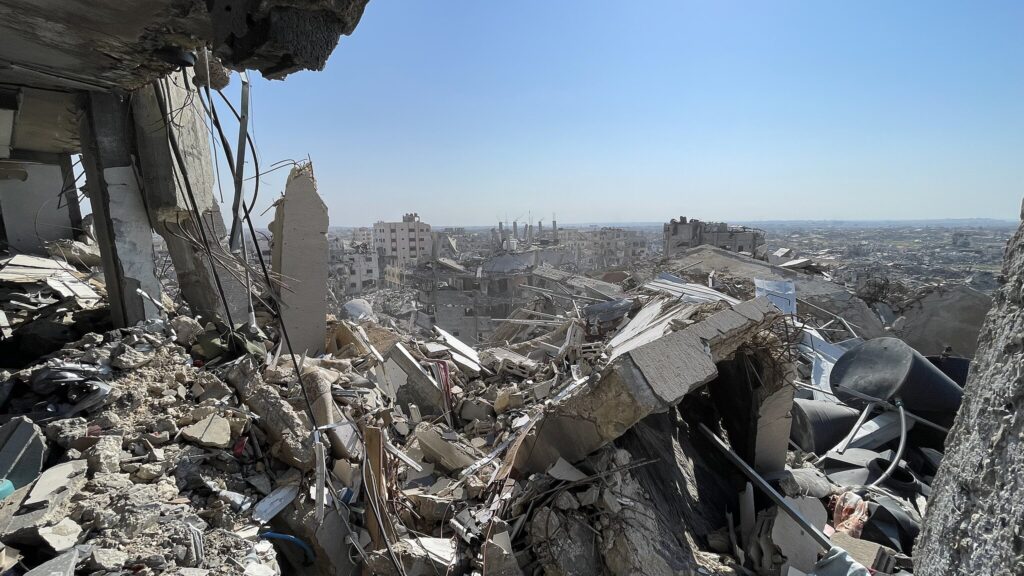
Image: https://commons.wikimedia.org/wiki/File:Gaza_war_2023_-_2025_IMG_3929.jpg
As well as the severe humanitarian situation in Gaza, the immense environmental destruction is of extreme concern. For this reason, the Australian environmental movement sees the destruction occurring in Palestine as an environmental and climate justice issue. Firstly, military bombardment has caused widespread destruction to Palestine’s natural assets, including wetlands, coastal areas, and Wadi Gaza – the main river in Gaza. This has had detrimental effects on the biodiversity of the region. Gaza is a unique biodiversity hotspot that sees the meeting of wildlife from Europe, the Middle East, and Africa. In terms of water pollution, since the beginning of the war, sewage treatment facilities in Gaza have not been operating. This has led to the extensive pollution of Wadi Gaza and aquifers in the region, which has also impacted irrigation infrastructure for farmland in Palestine. Given the region is already notoriously water insecure, the impacts to the aquifers and Wadi Gaza will have significant long-term impacts for the area.
Additionally, it is estimated that two-thirds of farmlands and agricultural sites have been destroyed in Gaza, potentially causing irreversible damage to the soil and lands of what was a fertile, biodiverse area. As of July 2025, it is likely only 1.5% of farmland in Gaza is suitable for agriculture. Military equipment has uprooted large areas of land, consequently thinning the top soil and impacting the soil fertility and quality. The Gulf region is already one of the most susceptible areas to climate disasters because of global climate change, and is particularly vulnerable to desertification, drought, and extreme heat. Thus Israel’s military assault is severely exacerbating Palestine’s environmental vulnerability. The long-term environmental impacts of the military assault brings into question the implications this will have on the future generations of Palestine, and their access to a safe and clean environment. Given the Australian environmental movement’s dedication to conservation and enhancing the natural environment, the widespread destruction to the natural environment in Palestine is extremely alarming. The recent destruction of Palestine’s national seed bank, which was the most comprehensive effort to preserve ecological heritage in the region, is indicative of the extensive ecocide unfolding. Given international law guarantees a right to all people to access a healthy environment, action must be taken to prevent further environmental and humanitarian catastrophe.
Furthermore, Israel’s war on Palestine has caused an unprecedented carbon footprint that is estimated to exceed the annual carbon emissions of at least one hundred individual countries. The assault on Gaza is therefore accelerating global climate change and, as mentioned, the Gulf region is already vulnerable to the effects of global warming. The carbon footprint from the war will only continue to rise when rebuilding efforts in Gaza commence, which will undoubtedly have long-term costs to the environment. It is suggested that even the clearing of rubble in Gaza will emit 80,000 tonnes of carbon dioxide emissions. It is also estimated that Israel’s military assault has resulted in 60 million tons of rubble in Gaza, full of asbestos, unexploded ordinances, and hazardous materials that will have lasting environmental impacts on the region. It is already causing adverse health conditions in Gaza that presently cannot be managed, and thus the Australian environmental movement demands the Australian Government do more to prevent further negative climate outcomes.
The open letter, therefore, calls on the Australian Government to publicly and comprehensively advocate for Israel to abide by international law. It further urges that the Australian Government end cooperation with Israel, stop the supply of weaponry and military parts to Israel, and advocate for a political solution that ends the prevailing occupation of Palestine. In doing so, the Australian environmental movement hopes that steps can be taken towards a lasting peace in Palestine, and the current environment justice issues can be adequately addressed. The United Nations Human Rights Council guarantees that access to a healthy environment is a human right. Not only is the environmental quality of Palestine a concern, but the significant carbon footprint as a result of the war must be immediately addressed.
Further links: