
The Conservation Council has announced the winners of the annual ACT Environment Awards. The Awards are an annual celebration of Canberra’s environmental community, recognising hard work of so many in community to protect our nature and climate. This year we handed out four awards to deserving winners. Details of the winners are below.
Young Environmentalist of the Year Award
This annual award is in memory of Moira and John Rowland who were lifelong committed environmentalists and played a lead role in establishing the Canberra Environment Centre and the Conservation Council ACT Region. The Moira and John Rowland Young Environmentalist Award recognises young achievers committed to improving our environment. The Award goes to an individual, or group of individuals, aged 28 or younger, living in the ACT Region, who, in the past 12 months, have made an outstanding contribution to protecting nature in the ACT region. This includes contributions towards a safe climate future.
Winner: Telopea Eco-délégués
The Telopea Eco-délégués are a committed and collaborative group of students who have demonstrated outstanding leadership in environmental sustainability within their school and the wider community. As members of a diverse, student-led eco-delegation, they work together to ensure that all voices are heard and valued, creating an inclusive environment where students of different ages and backgrounds feel empowered to contribute.
As a group, they have shown strong teamwork and shared responsibility in planning and delivering environmental initiatives. They have worked closely with peers, staff, and community organisations to raise awareness about key issues such as protecting the Great Barrier Reef, conserving endangered species, and promoting sustainable water use.
Their collective leadership is reflected in the successful organisation of four fundraising events, raising over $2,000 for environmental organisations including the Great Barrier Reef Foundation, Conservation Council ACT, and WaterAid. Through these efforts, they have combined advocacy with action, demonstrating the power of teamwork in creating meaningful change.
Beyond major events, the group consistently promotes sustainable practices in everyday school life, encouraging recycling, waste reduction, and energy conservation. By leading together and supporting one another, they have fostered a culture of environmental responsibility across the school.
Respectful, inclusive, and proactive, the group serves as a strong role model for their peers. Their shared commitment and collaborative approach have made a lasting impact and continue to inspire others to take positive action for the environment.
Special Recognition: Aurore Severac
Aurore is a dedicated and passionate student leader who has demonstrated outstanding commitment to environmental sustainability within both the school and the wider community. As an active member of a student-led eco-delegation, they have played a key role in promoting inclusivity, ensuring that students of all ages and backgrounds feel empowered to contribute to environmental initiatives.
Aurore is highly collaborative, working effectively with peers, staff, and community organisations to raise awareness about important issues such as protecting the Great Barrier Reef, conserving endangered species, and promoting sustainable water use. Their leadership has been particularly evident in organising four successful fundraising events, which raised over $2,000 for environmental organisations including the Great Barrier Reef Foundation, Conservation Council ACT, and WaterAid.
In addition to these larger initiatives, Aurore consistently promotes sustainable practices in everyday school life, encouraging recycling, waste reduction, and energy conservation. They lead by example and inspire others through their actions, fostering a culture of responsibility and care for the environment. Respectful, inclusive, and proactive, Aurore is a role model within the school community. Their efforts have made a meaningful impact and continue to inspire others to take positive action for the environment.
Working Together Award
At the heart of many successful environmental programs to protect nature or create a safe climate future are community groups. Problems are not always solved quickly but these groups help us work together to address environmental issues too large for an individual to tackle. The Working Together Award celebrates organisations or groups that have seized the opportunity to build momentum through people working together and are working on a program for the environment which has achieved significant results in the past 12 months. Even if the project is not at a point of ultimate success or completion, groups were eligible for the award where there has been a measurable milestone along the way or it is clear that they have mobilised and supported others to achieve success.
Highly commended: The Recyclery
The Recyclery at Gungaderra Homestead — known affectionately as “The Shed” — is a community-led bicycle repair and reuse initiative using practical action to support climate resilience, waste reduction, and social connection in Canberra.
Run by two part-time staff, three community bike mechanics, two casual employees and 12 volunteers, The Shed provides affordable refurbished bikes, repair support, workshops and open community repair sessions. It has become a welcoming hub where people can learn practical skills, share knowledge, and participate in hands-on environmental action.
The Shed operates on circular economy principles: donated bikes and parts are repaired, reused, and returned to the community rather than discarded.
Over the past 12 months, the Recyclery expanded its operations, educational programs, and community engagement activities in response to growing demand. This included, amongst other activities, expanding opening hours, increasing volunteer participation, and continuing the collection, repair, and redistribution of donated bicycles and parts through a community-powered reuse model. The Shed also strengthened its role as a learning and participation space through regular Bike Kitchen sessions, where community members can access repair support, share knowledge and develop practical maintenance skills. Recognising the importance of inclusive participation, The Shed established a dedicated Women and Gender Diverse People’s Bike Kitchen to create a more supportive environment for broader community involvement.
Alongside environmental outcomes, the initiative also creates social benefits by building confidence, reducing barriers to cycling, and fostering a strong sense of belonging among volunteers and participants.
Highly commended: ACT Council of Social Services (ACTCOSS)
ACTCOSS is the peak body for the community sector in the ACT. It enjoys strong relationships with the ACT Government and has several staff members with expertise in climate adaptation and the community sector, with a total of 26 peer reviewed publications on these topics.
Delivered over 2025, ACTCOSS led a climate adaptation planning pilot with ten organisations. The program was designed for these organisations to develop Climate Adaptation Plans, with all participants successfully completing a plan. The work involved assessing climate risks across key areas, including premises and physical assets, physical and psychosocial health, financial and economic strain, and service delivery dependencies. ACTCOSS provided coordination, technical expertise, and structured support, enabling diverse community organisations to engage in adaptation planning in a practical and achievable way, building capability across the sector.
The pilot demonstrated how effective, collaborative governance can address complex environmental challenges beyond the capacity of any single organisation. The model empowered organisations that are often under-resourced to meaningfully engage in climate adaptation planning. Critically, the work strengthens continuity of essential services during extreme weather and climate shocks, helping ensure vulnerable and disadvantaged communities remain supported when they are most at risk. In doing so, it reinforces system-wide resilience by addressing interdependencies across organisations and services.
The success of the pilot has driven momentum beyond the initial cohort, leading to the development of a sector-wide Community Sector Adaptation Plan.
Winner: Friends of Grasslands (FOG)
Friends of Grasslands (FOG) is a community organisation committed to conserving the natural temperate grasslands and grassy woodlands of south eastern Australia. Its work spans advocacy, education, ecological surveys and on ground restoration. Based in Canberra, FOG brings together professional scientists, landowners, land managers and community members with a shared commitment to protecting these ecosystems. In the ACT, grassy ecosystems occupy the lower elevations between ridges and hilltops.
For this nomination, the focus is FOG’s advocacy. In 2022, Friends of Grasslands and the Conservation Council ACT Region released a paper calling for a Biodiversity Network for the ACT. Focusing on low lying grassy ecosystems and small remnants outside the reserve system, the paper proposed identifying Conservation Areas across public and leased land to secure biodiversity outcomes through protection, restoration and reconnection.
Since then, FOG has advanced this work by mapping and describing high value conservation areas outside reserves; articulating best practice approaches for protecting and managing low altitude grassy ecosystems; and developing a shared understanding of what a coordinated, cross tenure ecological management system should look like. This work has been undertaken collaboratively with land managers, policy makers, special interest groups, researchers and the broader community, strengthening the collective capacity to deliver landscape scale conservation.
Earlier this year, the Office of Nature Conservation sought public comment on the draft Nature Conservation Strategy, which will guide nature conservation in the ACT until at least 2036. Central to the draft strategy is the establishment of an ACT Nature Conservation Network—a connected, cross tenure system of protected and conserved areas.
FOG’s sustained advocacy has been instrumental in building the momentum that led to the inclusion of this network concept. FOG has demonstrated exceptional determination and an ability to work constructively across institutions to achieve broad scale change. The proposed Nature Conservation Network reflects a vision with the potential to deliver significant, enduring environmental outcomes.
Environmental Protection Award
The Environmental Protection Award goed to an individual or group of individuals living in the ACT region who, in the past 18 months, have made an outstanding contribution to protecting the region’s nature, including contributions towards a safe climate future.
Highly commended: Lyn Smith
Lyn Smith has played an important role in supporting recognition of dingoes in the ACT as native animals with ecological and cultural significance. Her major contribution has been bringing together experts, conservation advocates, community members, and others to combine their knowledge and influence. She has helped build a more informed conversation with the government about recognising dingoes as native animals rather than “wild dogs”. She emphasises the cultural significance of dingoes to ACT First Nations people and the need for First Nations voices to be included in government deliberations.
Lyn’s contribution has strengthened the case for an evidence-based dingo policy in the ACT. By connecting experts and advocates, she has helped the government hear a clearer, broader, and more credible case for recognising dingoes as native animals. Her work has supported a shift away from narrow pest-control thinking toward a fuller consideration of ecology, culture, humane management, First Nations involvement, and long-term coexistence.
Highly commended: Caroline Le Couteur
When COVID-19 curtailed her travel plans, recently retired Caroline Le Couteur accidentally took up community-scale gardening instead. An ACT government COVID employment program in Phillip had removed woody weeds, with apparently no plan to stop the weeds returning. This presented sizeable mulch piles, plus an opportunity – in Caroline’s eyes – to mobilise community and repair an unkempt stretch of grass along the commuter bike path from Mawson to Phillip.
The idea of Friends of Mawson Ponds (FoMP) was born.
A group of Woden Valley residents answered Caroline’s call for interest in creating a wildlife corridor of native plants. Always consultative, she became the driving force behind FoMP: writing applications for community grants to buy plants, equipment, water cubes, signage; creating and managing a Facebook page and e-news; securing a grant for ecologist Lori Gould to survey the adjacent remnant grassland and significant eucalypts; arranging community events; convening the weekly weekday working bees and bringing her little red car filled with gear – and morning tea!
Caroline’s gentle and welcoming nature, endless patience, and passionate commitment to the environment have fostered a growing group of dedicated gardeners who nurture a landcare site admired by locals and passing commuters alike.
Winner: Turtle Watch, led by Bruno Ferronato
Turtlewatch ACT is a citizen program involved in the monitoring and conservation of the Eastern long-necked in Canberra since 2020. Their trained volunteers help to conduct turtle sampling in ponds, wetlands and creeks, and turtle nest protection in Canberra. The Turtlewatch ACT program is led by the turtle ecologist Bruno Ferronato, who has been studying turtles in Canberra since 2011.
The program is based in the Ginninderra Catchment Group (GCG), and the group partners with local landcare groups and the University of Canberra. Turtlewatch ACT provides opportunities for volunteers to gain hands-on experience in field work and conservation, increase their knowledge on freshwater turtle biology, and help to protect a local species of turtle that’s threatened by urbanisation, road mortalities and fox predation on nests. Their volunteers are retirees, university students, landcarers, and people who are interested in turtles.
The group has had a significant impact:
- trained around 110 volunteers since the beginning of Turtlewatch ACT;
- have captured, marked and released over 580 Eastern long-necked turtles; and
- have protected more than 20 nests and released over 60 hatchlings back to the local wetlands.
The group has also gained a better understanding of the requirements for turtles living in the urban environment and the key role of habitat connectivity in urban ponds to sustain turtle populations. Such knowledge helps land managers to plan and design urban wetlands that are turtle friendlier. We now know that urban wetlands with good habitat connectivity act like nurseries for turtles, as they have a much higher number of juvenile turtles than unmodified creeks. They also studied where turtles are nesting in the urban areas and were able to suggest management strategies to benefit the turtles, such as timing of mowing around wetlands (paper in review). Additionally, they have helped to spread the word about turtle conservation and biology to the general public on radio interviews.
This has all be led by the work of Bruno, who deserves specific mention and credit for leading this important conservation work.
Lifetime Achievement Award
The Lifetime Achievement Award goes to an individual or group living or operating within the ACT region who have made an outstanding contribution to protecting the region’s nature, including contributions towards a safe climate future, over a long period of time. The judging panel examined either the lifetime of an individual, or the collective work of an organisation that have been in operation over a long period of time.
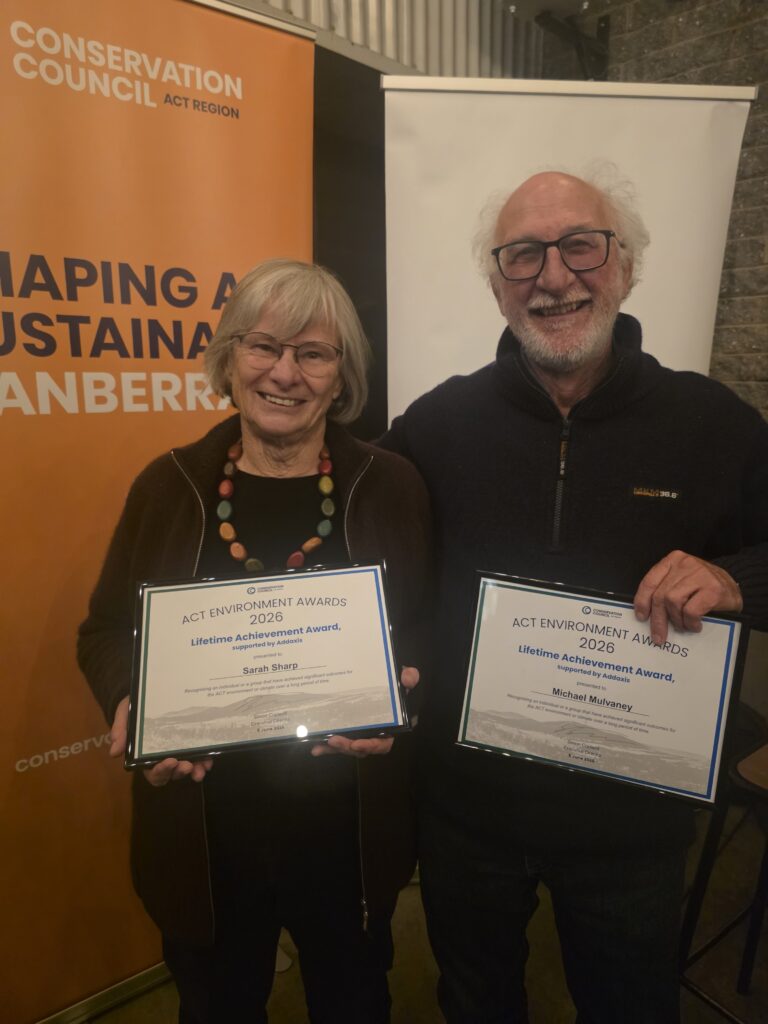
Sarah Sharp and Michael Mulvaney – joint winners of our inaugural Lifetime Achievement Award
Joint Winner: Michael Mulvaney
Dr Michael Mulvaney, whose PhD (1991) from the ANU established a predictive model to identify potential invasive weeds in SE Australia, is a Canberra-based botanist, biologist and ecologist with a career defined by a rare combination of scientific rigour and genuine community engagement.
He served as Senior Conservation Officer in the ACT Directorate of Planning and Environment, providing advice to the ACT Conservator of Flora and Fauna on planning and development decisions affecting biodiversity. In that role he brought deep expertise in ACT flora and fauna to decisions that shaped how Canberra’s natural areas were protected and managed.
Beyond his professional responsibilities, Michael has given generously of his time and knowledge to conservation volunteers, citizen scientists and students across the region. He was a board member of the Albury Conservation Company for approximately 15 years and previously worked for NSW National Parks and Wildlife Service, reflecting a career-long commitment that extends well beyond any single role or organisation. He is a member of the Canberra Ornithologists Group and has been a driving force in the volunteer‑led community-based Red Hill Regenerators Group, demonstrating continued hands-on involvement in local habitat restoration. This group has worked together over the past 40 years to transform Red Hill from degraded and weedy sheep paddocks to one of the most intact box gum woodlands in the ACT.
Michael is also a co-founder of the NatureMapr platform and its Canberra instance, Canberra Nature Map. This citizen-science project engaged community volunteers in photographing and recording plants, animals, fungi and more, to build a biodiversity database used for conservation and land management. In its first three years, the platform collected as many records of rare plants as had been recorded by anyone in the previous 100 years. The site ultimately reached a scale of approximately two million image downloads per month, driven by thousands of citizen scientists.
Michael has led conservation research projects such as Little Eagle ecological data collection and Gang-gang Cockatoo nesting ecology, engaging hundreds of community volunteers in observations contributing to the research, and has given his time generously to students studying environmental science at ANU.
Through all of this, Michael has delivered lasting, measurable benefits to the ACT’s natural environment across multiple fronts spanning science, community, and collaboration.
Joint Winner: Sarah Sharp
Sarah Sharp has made an extraordinary contribution to grassy ecosystem conservation in the ACT for over 30 years spanning both Government and non-Government sectors, undertaking advocacy, surveys and data collection, community education and on-ground works and in leadership roles in Friends of Grasslands (FOG).
As the Grasslands Project Officer for the ACT Government in the early 1990s, Sarah was part of the team undertaking the first comprehensive mapping of grasslands and in preparing Action Plans for grasslands and threatened grassland species.
Recognising the need to raise community awareness and drive local action, Sarah facilitated the establishment of Friends of Grasslands (FOG) in 1994, and following her departure from the public service, she served time as President, Vice President and advocacy coordinator. She was the driving forced behind the development of the ‘Biodiversity Network’ proposal, which has now been taken up as a guiding principle of the ACT Government’s recently released Nature Conservation Strategy.
Sarah’s early work within Government, alongside other Government ecologists, effectively put grasslands ‘on the map’, and she contributed to the critical documents that would underpin grassland recovery in the ACT. Her initiative to prompt the establishment of FOG to advance this work through advocacy, skill-sharing and community engagement, has directly contributed to a strengthened understanding of grasslands and grassy ecosystems and their incredible biodiversity in Government and amongst the landcare and environmental communities.
Sarah has brought her scientific background and training to the landcare community, helping to train landcarers as citizen scientists to undertake the necessary monitoring and to better understand ecological recovery and restoration. Her contribution to various field guides, protocols, and manuals has directly contributed to the landcare community’s knowledge base.
As FOG President, Vice President, and advocacy coordinator, and in other FOG roles, Sarah has contributed to grassy ecosystem conservation, her approach being collaborative, pragmatic and evidence-based, bringing experts together at conferences and seminars, advocating for the protection of native grasslands and woodlands in the face of suburban expansion, as well as informing and educating community members. Her work on the Biodiversity Network proposal will remain an enduring contribution to grassy ecosystem conservation.
Sarah’s collaborative and pragmatic approach has brought people to the table, creating the space for practical and achievable solutions for these underappreciated and undervalued ecological communities.