
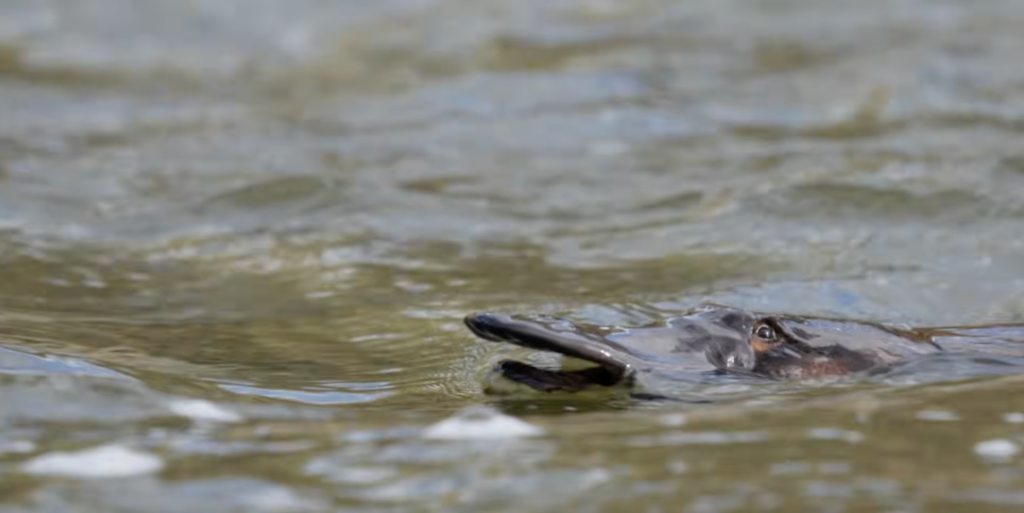
At dawn and twilight, along the Murrumbidgee and Molonglo rivers, is when you’re most likely to see one of the Western Edge’s more reserved residents. If you crouch quietly on the river bank, you may see the glide of a sleek body along the surface and a ripple as it plunges beneath to scoop water-bugs into its bill.
This shy friend would be the Mulanggang in the language of the Ngunnawal people, the Platypus in English, or Ornithorhynchus anatinus if you like Latin.
The Platypus is not a new resident. The fossil record places the Ornithorhynchidae/Platypus family as sharing Gondwanan rivers with Dinosaurs. The modern Platypus that swims in our rivers today has been around for 4 million years.
Gathered around a picnic table as dusk approaches, are more than a dozen volunteers and three Upper Murrumbidgee WaterWatch facilitators. Wrapped in warm clothes, they brace the evening chill to conduct a survey of Platypus.
‘If they pop up you won’t miss them,’ Martin Lind, Waterwatch facilitator, assures participants who’ve never seen Platypus. ‘They will dive down and fill their mouths up, but they have to come up to chew. If you’re lucky, they will roll onto their side and have a scratch.’
He picks up a fluffy toy platypus that is sitting on the picnic table, and makes its leg scratch its side.
The volunteers laugh, and the silver river behind Martin gurgles.
He places the toy Platypus back down on the table, among folders of observation sheets, mugs of tea and a tray of assorted Arnott’s biscuits, all the Monte Carlos eaten.
Each August, Waterwatch, a program run by the ACT’s Catchment Groups, surveys Canberra’s Platypus population. August signals courtship and mating season for Platypus in the Western Edge.
‘This is the time to see them,’ Tony Cory, a Waterwatch volunteer and water-bug expert, informs me. ‘The males are venturing out to find a female, and the females, particularly if they are lactating, can eat up to 100% of their body weight in bugs each day.’
He explains that while the season is still chilly, there are a lot less water-bugs in the rivers and so the Platypus spend longer foraging.
When diving beneath the water to forage for water-bugs or crayfish, Platypus close skin furrows over their eyes and ears. To navigate and locate prey, specialised sensory structures in their bill sense small electric fields and movement.
During the day, female Platypus are building complex burrows into firm river banks, often between tree roots. These burrows often have soil plugs to provide safety for their eggs or young offspring, from predators and rising waters.
In the Western Edge, urban development threatens the ecological niche that Platypus have evolved to live in. Land clearing disrupts the stability of the river banks, increases river sedimentation and has been known to cause localised Platypus extinctions.
‘When there was construction beside the Molonglo river, Platypus disappeared completely,’ Martin says solemnly.
Dusk has fallen and volunteers are watching the river for movement.
‘They came back a few years later,’ Martin continues. But he warns this isn’t quite a success story. ‘You’ve got to look at the whole conservation area. Once it’s been so altered, you don’t get it back.’
A concrete road is making a weir through the Murrumbidgee River, where Waterwatch are surveying. I ask whether Platypus can get around it.
‘Oh, they can get under the crossing.’ Martin says.
Tony adds that they also walk on land, ‘they fold the webbing back on their feet and they become claws.’
But when a Platypus is on land, they are at most risk of predation. In the Western Edge, cleared land and road traffic amplify the threat of foxes, domestic dogs and large birds of prey.
While disruption to Platypus habitat is happening at a major scale, they are not listed as a threatened species under ACT’s Nature Conservation Act 2014 or the Commonwealth Government’s Environment Protection and Biodiversity Conservation Act 1999. This is largely due to the difficulty of studying Platypus and a lack of data.
Despite their omission from formal threatened species lists, it is worth protecting these quiet neighbours of the Western Edge.
If you would like to experience the beauty of the waterways of the Western Edge, the Conservation Council is hosting a free walk from Stony Creek to the Murrumbidgee River on November 8. Tickets can be found here.
Keep an eye out for Waterwatch ACT’s ‘Platypus Month’ August surveys next time round. In the meantime there is a ‘Platty and Ratty Portal’ where you can see reported sightings of Platypus. It is still the season to spot Platypus, so find yourself a hot tea and sit quietly by the Molonglo or Murrumbidgee at dusk or dawn.
This post was prepared by Conservation Council volunteer Isobel Lasker.
Image credit: Trent Houssenloge, On the Edge