
This post was submitted by community member Emily Rasheed.
The bush of Canberra, the so-called ‘Bush Capital’ of Australia is under threat as population pressures rise. The Western Edge (WE), 9,800 ha of natural ecosystem and agricultural land has been zoned as potential greenfield development as a means of easing such pressures (see fig. 1). A campaign to ‘Save our Western Edge’, led by the Conservation Council ACT Region, recognises the inherent ecological, cultural and recreational value of the WE and calls on Canberrans to persuade the territory government to exclude it from their urban growth boundary (Conservation Council ACT Region, 2026). The response to campaign is examined as a case study and analysed using urban sociological lenses such as the omnipresence of the city’s historical context, agglomeration and urban sensibilities. A scenario where the WE is developed upon is considered, along with the perceived winners and losers of such.
Historical context
To examine a city and the present challenges it faces, it is important to understand it’s historical context, as a city’s past 1 echoes through its present and future evermore (Smith,
2026). Upon Australia’s federation in 1901, the difficulty in forming a unified body out of a collection of the states and their existing cities produced the imperative to constitute a new ideal city (Webb and Williams, 2015). One that possessed the following physical conditions laid out by the Commonwealth Government: “…sufficient expanse of rolling down country facing eastward, free from severe gradients on the one hand, and from the monotony of the large flat surfaces on the other, with a mountain background, and as many as possible of the adjuncts of an elevated plateau flanked by hills. Depressions should be avoided, or converted into artificial lakes, for which purpose the command of an ample water supply would be invaluable” (Wigmore, 1972). Canberra sure ticks those boxes. And thus, the ‘Bush Capital’ was established in 1913 (Lynch, 2022).
Agglomeration
As Australia’s population expands and the state of global politics continues to nuance, there grows a need for a more diverse and volumetric public service labour force in proximity to the Australian Parliament. The total Commonwealth Australian Public Service Workforce (APS) has risen from 166,000 in 2013 to nearly 198,500 in 2025 with the number of public servants in Canberra increasing from 64,300 in 2013 to 70,221 in 2025 (APSC, 2025). This APS workforce attraction in Canberra sets into motion what sociologists call ‘agglomeration’ whereby economic activities from labour and infrastructure concentrate (Fang and Yu, 2017) and advances into reinforcing feedback that attracts more business and residents. On a broader scale, census data from 2011-2021 reveal that 2 professionals and managers dominate the Canberran workforce; a combined 44.3% in 2011 and 58.6% in 2021 (ABS, 2011; ABS 2021). Canberra’s natural beauty and economic security facilitates agglomeration and retention simultaneously, creating a kind of ‘stickiness’, or what I’d like to call ‘ag-glue-meration’. People who grow up or migrate for work tend to stay (Profile ID, 2021) and start families (ABS, 2021). Canberra’s population is projected to grow by 215,200 people by 2050, highlighting the criticality of a long-term plan for housing and employment land (City and Environment Directorate, ACT Government, 2025).
The median income of a Canberran resident is well above the national median: $1,158 vs $789 per week (ABS, 2023). This upper middle-class majority is a key component in Canberra’s spatial agglomeration phenotype. As described by Booi and Boterman (2020), a city with a relatively high income shapes a city to cater towards a suburban lifestyle, because residents prefer to live in low density houses in suburbs further from town centres (see fig. 1). It is recognised that continuing the current housing density trends (i.e., average of 1,080 residents per km 2 ) for the projected population growth is ecologically unsustainable and puts enormous pressure on environmentally sensitive areas (ACT Government, 2019). The ACT Planning Strategy 2018 (2018) look to develop medium to low density housing in identified greenfield development zones, like the Western Edge (WE) (see fig. 1), which contain intact areas of critically endangered Box-Gum Grassy Woodland, Natural Temperate Grassland
(Office of the Commissioner for Sustainability and the Environment, 2025).
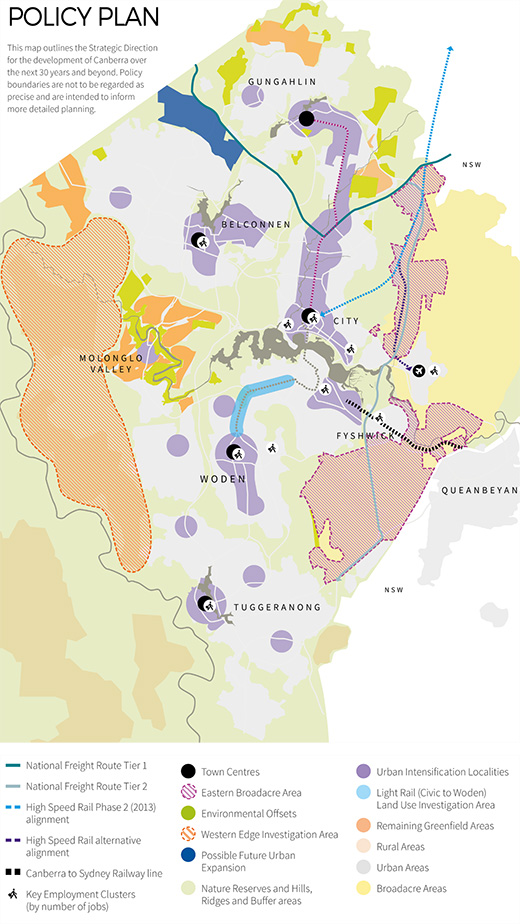
Figure 1: WE relative to Canberra’s existing urban footprint Source: ACT Planning Strategy, 2018
The urban (in)sensibility
Agglomeration introduces more people, yet, paradoxically, shifts the urban sensibilities to be less focused on community, and manifesting through what Simmel (1903) coins ‘a blasé attitude’ in which urban dwellers develop apathy, indifference and detachment as psychological responses to sensory overload and social intensity. Such an attitude is characterised by emotional withdrawal from people and places that do not directly impinge upon the individual’s immediate interests (Simmel, 1903). In Canberra, this urban sensibility seems to manifest as individualism, a tendency likely intensified by the city’s low-density suburban form, high rates of private home ownership, and car-dependent lifestyles, as discussed by Jackson (1985). Urban sociology literature like Putnam’s book Bowling Alone (2000) demonstrates that suburban spatial arrangements foster a ‘me rather than we’ attitude among citizens, which diminishes everyday social interaction and civic responsibility. Personal comfort and family autonomy are prioritised and collective responsibility as a city is never taken on by the citizens (Harris, 2015).
These attitudes shape the urban sensibility of Canberra to be one that breeds subconscious indifference and mental disconnection towards the collective urban resources that connect us. The lack of connection over a shared cause acts as a barrier for against community building, involvement in change and resistance movements (McGeady, 2000). The ‘community’ response to the Save Our Western Edge campaign, a movement that aims to protect the WE through environmental and cultural heritage conservation legislation, can be seen as a test to see how these sensibilities play out. The Save our Western Edge petition seeking to permanently remove the WE from potential development plans and protect it through legislation, has 1,506 signatures as at 11 March 2026 (Conservation Council ACT Region, 2026), which equates to 0.42% of the 337,056 estimated eligible voters in Canberra (AEC, 2025). From personal experience with their campaign, majority of the support and campaign event participation are retirees who presumably grew up in Canberra at a time without such strong agglomeration effects on the urban sensibility, therefore perhaps more immune to the ‘blasé’ and ‘me rather then we’ attitudes, thus more engaged through political activism rather than rife passivism being observed by the majority.
Winners and losers
As of February 2026, no decision has been made on whether any development will proceed in the WE due to preliminary investigations (City and Environment Directorate, 2026). Key findings reflect the presence of critically endangered ecological communities supported by riparian zones that flow into our water supply systems, and landscape forms act as a natural bushfire barrier for the current urban boundary.
The answers to the question of who wins and loses in the case of developing the WE rest upon what values are prioritised and how they weigh up against the strength of the urban challenges Canberra faces. Human and environmental health are the clear winners of a protected WE. Endangered endemic floral and faunal communities can continue to thrive in their natural rhythms with low human impact upon them. Protecting the land means maintain the high water and air quality that has been enjoyed pre and post colonisation. The quality was both would inevitably lower due to changes to water course hydrology and increased vehicular, commercial/residential emissions associated with urbanisation (Office of the Commissioner for Sustainability and the Environment, 2025). The beneficiaries of developing in the WE are new Canberrans who would live in these houses, However, if development does take place, it would exponentially increase the bushfire risk of the urban settlements with time, which would threaten many human and non-human lives and put immense economic pressure on the government and people to rebuild damaged property. If the Western Edge is taken, it will ease housing pressures on Canberra created by agglomeration in the short term. But the economic value of development on this land may decrease as the processes of agglomeration continue, meaning the property developer’s victor will diminish over time (Fukuda, 2020). As previously identified, enhanced urban agglomeration will continue to advance the insensibilities of Canberrans and justify this idea that Canberra is ‘a city without a soul’ (Webb and Williams, 2015). In short, Canberrans who live in the WE adjacent suburbs, care about endangered ecosystems, wish to develop property in the WE, pay taxes, drink water or ever wish for their city to become resensitised and community-focused, will be the ‘losers’ (varying degrees) if development takes place.
It is important to understand that the centralisation of power for a colonial federation is the historical context in which Canberra was laid upon. And that this context has led to a unique agglomeration dominated by an upper-middle class, with a taste for low-density houses in a suburban layout. Agglomeration has enhanced the blasé attitudes that plague the Canberran urban sensibilities, paradoxically making people less sensitive, and reshaping community life, into a kind that normalises individualism and lacks cohesion. This combination threatens our city’s ability to collectivise and take grassroots action to protect the literal grass roots of the Western Edge from being turned into the same lower density housing that exacerbate these urban sensibilities through spatial and social insulation. It would be a safe bet to assume each Canberran, present or future will be a ‘loser’ if the WE is included in the urban growth boundary, because of the environmental, health and social consequences associated with this particular greenfield development.
Reference list
ACT Government 2018. ACT Planning Strategy 2018. Australian Capital Territory Government.
ACT Government 2024. Statement on progress in considering an urban growth boundary. Australian Capital Territory Government.
ACT Legislative Assembly 2025. Western Edge Strategic Planning and Environmental Assessment: Preliminary Investigation Findings. Parliament of the ACT.
ACT Legislative Assembly n.d. Western Edge environmental and planning investigation report. Parliament of the ACT.
Australian Bureau of Statistics (ABS) 2021. 2021 Census QuickStats: Canberra.
Australian Bureau of Statistics (ABS) 2023. New Census insights: Income in Australia using administrative data.
Australian Electoral Commission (AEC) 2025. Enrolment statistics by state and territory.
Australian Public Service Commission (APSC) 2025. APS workforce size and location. State of the Service Report 2024–25.
Booi, H. and Boterman, W. R. 2020. Changing patterns in residential preferences for urban or suburban living of city dwellers, Journal of Housing and the Built Environment, 35(1): 93–123.
Brown, N. 2014. A history of Canberra. Cambridge University Press.
Conservation Council ACT Region n.d. Save the Western Edge.
Fang, C. and Yu, D. 2017. Urban agglomeration: An evolving concept of an emerging phenomenon, Landscape and Urban Planning, 162: 126–136.
Fukuda, Y. 2020. Land prices and agglomeration: Theory and evidence from the Tokyo metropolitan area, Journal of the Japanese and International Economies, 58: 101094.
Harris, R. 2015. Suburbanization and Suburbanism, International Encyclopedia of the Social & Behavioral Sciences.
Jackson, K. T. 1985. Crabgrass Frontier: The Suburbanization of the United States. New York: Oxford University Press.
Lynch, A. J. J. 2022. The ‘Bush Capital’—A Review of 100+ Years of Integrative Spatio-Temporal Planning for a City in the Landscape and Nature in the City, Land, 11(2): 169.
McGeady, J. G. 2000. Community in suburbia: The effect of neighbourhood design on sense of community and civic engagement. PhD thesis, Purdue University, Indiana.
Smith, G. 2026, pers. comms, 2 February, Australian National University.
Webb, J. & Williams, J. 2015. Canberra: ideal city, imagined city, Continuum, 29(3):490–503.
Wigmore, Lionel 1972, Canberra, Dalton Publishing Company, Canberra. (First published 1963 as The Long View, Cheshire Pty. Ltd.).