
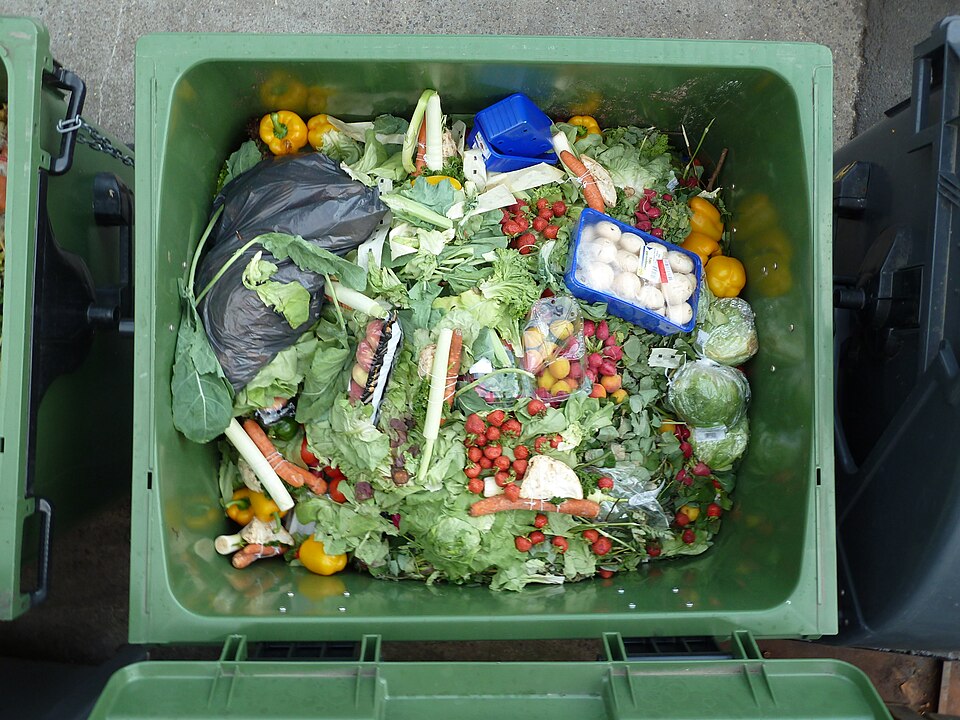
It’s no secret that Canberra has a food waste problem.
The ACT sends approximately 26,000 tonnes of food waste to landfill every year, contributing to greenhouse gas emissions and constituting an enormous waste of resources (ACT Government, 2023).
A Food Organics and Garden Organics (FOGO) recycling scheme offers a way of tackling this food waste problem, yet repeated delays have prevented a territory-wide rollout.
Food waste is a significant contributor to climate change. According to the United Nations Environment Programme (UNEP, 2025), food loss and waste generates an estimated 8-10% of global greenhouse gas emissions. When food waste decomposes in landfill, methane is produced, a greenhouse gas responsible for 30% of current global warming (IEA, 2022). Furthermore, producing food requires vast amounts of land, water, fertilisers, and energy, meaning wasted food also represents a loss of finite resources and impacts on biodiversity.
FOGO helps address these impacts by preventing food scraps from reaching landfill, diverting them instead into processing for compost and other useful resources, such as biogas. This supports a circular economy, returning nutrients to the soil, improving soil health and food production. Implementing FOGO in the ACT represents a sustainable solution to managing avoidable waste.
The ACT first proposed a FOGO scheme in 2018, recognising the need to cut greenhouse gas emissions, reduce landfill, and build a local circular economy. In November 2021, a collection pilot was launched, initially serving approximately 5,000 households across Belconnen, Bruce, Cook, Macquarie and selected areas of Tuggeranong. The program has since expanded to include 1,100 additional households. The pilot has demonstrated promising results, collecting more than 5,000 tonnes of food and garden waste, yet territory-wide implementation has repeatedly been postponed.
The ACT Government’s original target of introducing a territory wide FOGO scheme in 2023 was set out in its 2019-25 Climate Change Strategy. The rollout was subsequently delayed to 2026 following the destruction of Canberra’s main recycling centre in a fire on Boxing Day 2022, and has since been pushed back to 2028, with the latest target now set for 2030. Because of these delays, most ACT households lack access to a convenient way of recycling food waste, meaning that organic waste continues to enter landfill.
The ACT is now far behind other jurisdictions and local councils who have successfully implemented FOGO schemes. For example, 59% of South Australian councils have now implemented FOGO waste collective schemes and improved kerbside systems collect FOGO weekly and landfill fortnightly (Local Councils, 2025) . Early trials have reported landfill waste reductions of 23-42%, demonstrating the success of effective organic waste collection (Local Councils, 2025). With the right implementation and support from the Government, Canberra could achieve similar results.
Despite delays in the rollout, Canberrans can act now to reduce their food waste by:
- Planning meals and shopping with a list to avoid buying more than necessary.
- Storing food correctly, freezing leftover food and using leftovers creatively.
- Checking date labels and prioritising food approaching its use-by date.
- Composting food scraps at home using compost bins, worm farms or bokashi systems.
- Donating suitable surplus food to local food rescue organisations, such as OzHarvest Canberra.
- Taking the ACT Government’s free three-week Food Waste Challenge to build better habits and save money.
Canberrans can get involved in SEE-Change’s WasteLess Group, a local community group that works to reduce waste and consumerism in Canberra, with a particular focus on food waste and plastic pollution. The group encourages Canberrans to adopt more sustainable habits, such as composing food scraps, using reusable products and reducing unnecessary consumption.
Many community-run local events, such as the National Folk Festival and The Forage Festival, have also taken steps to recycle their food waste and turn it into compost for local farms. In 2026, the National Folk Festival partnered with a Braidwood farm to process around seven tonnes of organic waste into fertiliser, while The Forage worked with Jillamatong Farm to compost food scraps and compostable packaging. These initiatives demonstrate that local partnerships can help divert organic waste from landfill and could help inform the ACT Government FOGO scheme by highlighting the importance of reliable composting infrastructure and collaboration with local partners.
Ultimately, the ACT Government urgently needs to implement FOGO across all Canberra suburbs to prevent further waste from entering landfill, and to ultimately reduce the territory’s emissions. Community initiatives demonstrate that collaboration and effective composting partnerships can make a difference with food waste. However, individual action cannot replace vital infrastructure to address food waste at a larger scale. The ACT Government must deliver a reliable, accessible FOGO service for all households to ensure food waste does not end up in landfill.
This post was contributed by Conservation Council volunteer Elena Laurans.
Image Credit: Treasure trove of wasted food by Foerster via Wikimedia Commons, CC0 1.0
