
This post was prepared by Conservation Council volunteer, William Jones.
Undeniably, governments urgently need to take steps to address barriers and inequalities in housing. One solution that the ACT Government is currently investigating is to expand Canberra’s urban area further beyond its current city limits and into Canberra’s Western Edge, 9800 hectares of undeveloped land encompassing areas of critically endangered woodland, grassland and agricultural areas bordering the Murrumbidgee River. However, the ACT Government’s Western Edge Investigation overlooks another, more environmentally, economically, and socially beneficial solution to the housing crisis: urban infill, coupled with transport-oriented design, to create a more compact, liveable city. Compact cities are more energy- and resource-efficient, create better health outcomes for their residents, are more socially equitable, and, crucially, provide more housing capacity without needing to expand further outward.
A compact city is more space-efficient
Canberra is currently one of the least densely-populated cities in Australia, let alone the world, with a density of 205 people per km2, compared to Sydney at 449/km2 and Melbourne at 544/km2. It is important to note that increased population density, as created by a compact city, does not imply overcrowding. Rather, carefully increased population density can better optimise population distribution, resulting in more people living in close proximity to their jobs, shops, recreational facilities, and transport options (Institute for Transportation & Development Policy [ITDP] n.d. a). Compact cities aim to maximise the efficiency of land use within a city, while limiting environmental impact and preserving rural and natural land (ITDP n.d. b; Bullard 2020). This includes preserving green spaces within cities, as these are just as essential to the functioning of a city as human infrastructure (Bibri et al. 2020; Bullard 2020). Additionally, by avoiding urban sprawl, compact cities prevent land degradation and destruction of habitats outside the city (ITDP n.d. d). A more compact Canberra would therefore remain the “Bush Capital” and would keep the Western Edge intact as the natural barrier to sprawl, and the bushfire, flood and heat buffer zone for thousands of Canberrans, that it currently is.
A compact city is better for the climate
In a compact city with transport-oriented design, travel distances are naturally reduced, resulting in fewer greenhouse gas emissions due to shorter travel times. This is especially true when paired with zero-emission transport options such as electric trams and buses, walking, or cycling (ITDP n.d. d; Bullard 2020; Fan et al. 2025; Public Transport Association of Canberra [PTCBR] 2026). This effect can be seen even in cities not specifically designed for compactness; city centres in the US, for instance, may emit just a third of the greenhouse gases per capita that their associated urban sprawl emits. This effect is only increased by consciously designing for compactness and environmental benefit (ITDP n.d. d). Compact cities also reduce traffic by reducing the size of road networks and individual roads. Bigger roads tend to only create more traffic, in a phenomenon known as “induced demand”, and conversely, decreasing the scale of roads can reduce demand, as alternative transport methods become both more appealing and, with city compaction, more viable than driving (Duranton & Turner 2011; Steutville 2021).
A compact city is happier and healthier
Compact cities also create a variety of social and health benefits for their residents compared to urban sprawl. Building cities on a human scale reduces residents’ reliance on cars, which in turn reduces expenditure on car maintenance while providing additional opportunities for and encouragement of exercise as walking and cycling become viable transport alternatives (ITDP n.d. c; Planning ACT n.d. c). Even for residents who prefer cars, compact cities reduce commute times, especially if used in conjunction with transport-oriented design, as efficient public transport networks reduce traffic congestion (ITDP n.d. c). Reducing congestion and traffic is of particular importance to residents’ health, as higher rates of both are linked to poorer air quality, more noise pollution, worse health outcomes, and higher stress levels (ACT Government 2012). Overall, it was estimated that the social cost of congestion in Canberra in 2007 was already at $110 million (ACT Government 2012), a figure which has surely increased since. Ensuring that all transport networks are integrated with each other – that is, that different methods of public and active transport are planned and run in a coordinated fashion, are physically connected, and have low interchange times – is also important, as it creates a smoother, faster, healthier, and lower-stress transport experience (ACT Government 2012; Charles 2019; ITDP 2026).
A compact city is more equitable
Compact cities can also be more socially equitable, providing an opportunity to create equal access to jobs and public spaces (ITDP n.d. c; Bibri et al. 2020). By prioritising walking and cheap public transport, transport-oriented design allows marginalised groups without car access, such as people in lower income brackets, people with disabilities, and children and the elderly, to gain independent, quick, and cheap access to work, education, and public spaces (ITDP n.d. d). Compact cities further benefit children by shifting transport routes away from child- and pedestrian-focused areas, thereby reducing the risk of injury (a benefit that also applies to people with reduced mobility), and by reducing the risk of asthma (ITDP n.d. a, d).
A compact city is cheaper
Financially, compact cities also make sense. Developing a compact city, especially via urban infill, is significantly cheaper in the long term than creating urban sprawl through greenfield development. While greenfield development is cheaper up-front for developers, this does not account for the downstream costs to the government of maintaining the extra kilometres of infrastructure required for developments far from the city centre, let alone the social costs of a sprawling city outlined above (Sipe 2024; PTCBR 2026). Compact cities also naturally avoid the high additional cost of creating entirely new infrastructure in distant locations, as compared to linking up an infill development to nearby resources (Sipe 2024).
Canberra is already well-placed to become a compact city
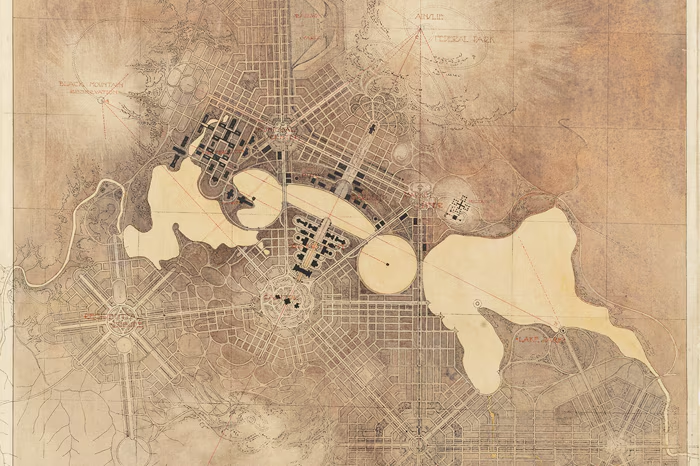
It is important to note that creating a compact city is not a panacea. These solutions need to be implemented with care and consideration to avoid problems such as increased noise pollution and gentrification (ITDP n.d. d; Bibri et al. 2020; Bullard 2020). Urban infill in conjunction with transport-oriented design can help to mitigate these risks, as can dedicated planning (ITDP n.d. d; ACT Government 2012; Bibri et al. 2020; Fan et al. 2025). Fortunately, Canberra can thrive as a compact city by building on the foundations of the Y-Plan of the 1960s, which designed the city as one with multiple distinct town centres, connected by a strong central “spine” for both public and private transport (Wensing 2026). This design allows the city to avoid some common pitfalls of compact city design, as mono-centric city structures can increase, rather than decrease, carbon emissions (Fan et al. 2025). While the Y-Plan has in its own way created a spread-out city (Kenny 2020), creating urban infill in an intelligent manner, supplying the Missing Middle, and creating better public transport networks along the existing transport corridors established by the plan will allow Canberra to grow in a more compact, efficient manner than it currently is (Wensing 2026).
The ACT Government has acknowledged compact city design, urban infill, transport-oriented design, and integrated transport as important, viable, and sustainable strategies for Canberra’s growth, with the ACT Planning Strategy aiming to build 70% of new homes in existing urban areas, alongside the recent commencement of the Missing Middle Housing reforms (Planning ACT n.d. a; b; c; YourSay n.d.; ACT Government 2012). This is a commendable goal, and the Missing Middle reforms are welcomed by the Conservation Council — yet it sits in stark contradiction with the Government’s ongoing Western Edge Investigation. With Canberra’s urban boundary due to be set in 2027, the Conservation Council is calling on the ACT Government to keep the Western Edge outside that boundary, take it out of its development plans, and protect it for its ecological, cultural and recreational values.
Compact cities using transport-oriented design are more cost-effective and resource-efficient; produce better mental health, physical health, and social outcomes for their residents; and are better for the environment in terms of both greenhouse gas emissions and land use. Urban infill is therefore a far better solution for creating new housing than urban sprawl, and one that the Conservation Council calls on the ACT Government to pursue going forward. If you agree that Canberra can meet its housing needs without sacrificing the Western Edge, add your voice by signing the Save Our Western Edge petition to the ACT Legislative Assembly.
Sources
ACT Government 2012. Transport for Canberra: Transport for a sustainable city. Environment and Sustainable Development Directorate. Via PTCBR: https://ptcbr.org/wp-content/uploads/2023/08/TransportForCanberra_Policy.pdf
Bibri, S. E.; Krogstie, J. & Kärrholm, M. 2020. ‘Compact city planning and development: Emerging practices and strategies for achieving the goals of sustainability’. Developments in the Built Environment vol. 4. Via ScienceDirect: https://www.sciencedirect.com/science/article/pii/S266616592030017X
Bullard, E. 2020. Compact City. Via EBSCO: https://www.ebsco.com/research-starters/environmental-sciences/compact-city
Charles, P. 2019. What does transport integration really mean? Via Transport Futures Institute: https://transportfutures.institute/what-does-transport-integration-really-mean/
Duranton, G. & Turner, M. A. 2011. ‘The Fundamental Law of Road Congestion: Evidence from US Cities’. American Economic Review vol. 101 no. 6, pp. 2616-52. Via American Economic Association: https://www.aeaweb.org/articles?id=10.1257/aer.101.6.2616
Fan, T.; Ren, Y.; & Chapman, A. 2025. ‘Unveiling the carbon neutrality pathways of compact cities: a simulation-based scenario analysis from China.’ Humanities and Social Sciences Communications vol. 12, no. 1205. Via Nature: https://www.nature.com/articles/s41599-025-05545-w
Institute for Transportation & Development Policy n.d.:
- a) The Eight Principles of TOD. Accessed 3 June 2026. https://tod.itdp.org/what-is-tod/eight-principles-of-tod.html
- b) TOD Standard Framework. Accessed 3 June 2026. https://tod.itdp.org/tod-standard/tod-standard-framework.html
- c) What is Transit-Oriented Development (TOD)? Accessed 3 June 2026. https://tod.itdp.org/what-is-tod.html
- d) Why TOD Matters. Accessed 3 June 2026. https://tod.itdp.org/why-tod-matters.html
Institute for Transportation & Development Policy 2026. Why All Cities Need Well-Managed, Well-Funded Public Transport. https://itdp.org/2026/05/01/why-all-cities-need-well-managed-well-funded-public-transport/
Kenny, M. 2020. ‘Canberra confidential: from Y-plan to why plan?’ Via ANU College of Arts & Social Sciences, Research School of Humanities & the Arts: https://rsha.cass.anu.edu.au/news/canberra-confidential-y-plan-why-plan
Planning ACT n.d.:
- a) Missing Middle Housing Reforms. Accessed 3 June 2026. https://www.planning.act.gov.au/planning-priorities/missing-middle-housing-reforms
- b) Southern Gateway Planning and Design Framework. Accessed 3 June 2026. https://www.planning.act.gov.au/planning-projects/southern-gateway-planning-framework
- c) Transport Oriented Development. Accessed 3 June 2026. https://www.planning.act.gov.au/planning-priorities/transport-oriented-development
Public Transport Association of Canberra 2026. Light Rail Mythbusters: #2 – Light Rail and BRT. https://ptcbr.org/2026/05/24/light-rail-mythbusters-2-light-rail-and-brt/
Sipe, N. G. 2024. ‘City planners love infill development. So why are cities struggling with it, and how can they do better?’ The Conversation. https://theconversation.com/city-planners-love-infill-development-so-why-are-cities-struggling-with-it-and-how-can-they-do-better-223189
Steuteville, R. 2021. Reduced demand is just as important as induced demand. Via Congress for the New Urbanism Public Square: https://www.cnu.org/publicsquare/2021/03/19/reduced-demand-just-important-induced-demand
Wensing, E. 2026. Protecting Canberra’s Western Edge by limiting Canberra’s urban sprawl. https://open.substack.com/pub/edwensing/p/protecting-canberras-western-edge?utm_campaign=post-expanded-share&utm_medium=web
YourSay n.d. Moving Canberra: Integrated Transport Strategy. Accessed 13 July 2026. https://yoursayconversations.act.gov.au/moving-canberra